






4 November 2026 | Engineering
Language Should Ride Shotgun, Not Stall the Control Loop
The role of semantic intelligence in physical control and safety assurance.
Language is becoming a powerful part of embodied AI. It can enrich learned representations, provide dense supervision, retrieve and organize difficult data, encode goals and preferences, and create a natural interface between people and machines. Language also provides broader semantic and contextual knowledge about activities, conventions, and relationships. Grounded in the driving scene, this knowledge can help a vehicle interpret situations, anticipate how they may develop, and inform the driving intent.
The challenge is to turn that capability into measurable safety benefits, as better reasoning, understanding, and stronger semantic intelligence do not replace learned safety capabilities or rigorous system-level verification and validation.
A plausible chain of thought does not prove that the action was caused by the stated reasons, that the trajectory is physically feasible, or that the system will remain safe when language is late, ambiguous, contradictory, or wrong. Those properties must be established through closed-loop behavior, controlled interventions, target-hardware performance, failure handling, and system-level validation.
Wayve began exploring this frontier with LINGO-1 in 2023 and LINGO-2 in 2024, progressing from an open-loop driving commentator to a closed-loop model linking vision, language, and action. That work points toward a closer connection between language, grounded understanding, and driving decisions, with clear operating contracts and evidence for their safety.
In this sense, language “rides shotgun” helping the AI Driver understand context, anticipate hazards, and inform intent. The contribution must be judged by the resulting driving behavior, alongside the physical competence and safety responsibilities of the complete system.
At Wayve, we see language and reasoning as important contributors to driving intelligence across learning and, selectively, at runtime. But we do not make free-form linguistic deliberation a blocking dependency for time-critical control. Here’s how:
1. Separate explanation from competence
A system can produce a plausible explanation without that explanation faithfully reflecting how an action was chosen. Even a faithful explanation does not establish that the action is safe. Producing an explanation, establishing its faithfulness and demonstrating safe driving are different claims, and each requires different evidence.
a) Fluency is not causality – A model’s training objective and grounding matter as much as the fluency of its output. A driving rationale may accurately reflect the scene and still be a post-hoc narrative rather than the mechanism that determined the trajectory.
Shared generation of text and action can strengthen alignment, but it does not by itself establish causal faithfulness. Testing should examine controlled changes to the cited scene evidence and, where accessible, the reasoning process. Agreement between a stated reason and a trajectory is not enough.
The goal is not to choose between a competent driver and an articulate one. It is to use semantic understanding to improve driving decisions, learned safety to anticipate risk and support timely protective responses, and rigorous system-level verification and validation to establish evidence for the safety of the complete system.
b) Interpretability is not validation – Many high-performing perception and control components do not explain themselves in natural language. Their value comes from measurable behavior: accuracy under relevant conditions, calibrated uncertainty, timing guarantees, closed-loop robustness, and known failure envelopes.
Conversely, a system can describe a hazard perfectly and still respond too late or with an infeasible maneuver.
c) Semantics still matter – The distinction is not between meaning and motion. Driving is saturated with meaning: a red light, a school crossing, a hand signal, a temporary restriction. That meaning can help a vehicle connect an unfamiliar situation to knowledge learned elsewhere, but it must remain grounded in the scene.
The distinction is between semantic information and a serial, free-form language process. Semantic features may be embedded deeply inside the driving policy without requiring the vehicle to compose sentences before it steers or brakes.
2. Assign distinct contracts to meaning, motion, and protection
A production architecture should make these responsibilities explicit. They don’t need to be three separate neural networks, and they may share learned representations. What matters is that their timing, authority, inputs, outputs, and failure behavior are defined explicitly and evaluated together. The learned driving, risk-anticipation, and self-awareness responsibilities described in “How Wayve Builds a Safe AI Driver,” remain essential as language and reasoning capabilities develop.
Human competence offers a useful analogy—not because the brain contains literal “System 1” and “System 2” modules, but because fast sensorimotor loops regulate action while deliberate reasoning is recruited selectively for interpretation and planning.
We do not think in words about each steering correction, pedal movement, gap adjustment, or evasive response. Deliberate thought can support decisions such as choosing a route, positioning across lanes for a difficult transition, interpreting restrictions, or forming a longer-horizon strategy.
The objective is richer understanding coupled with timely, physically competent action.
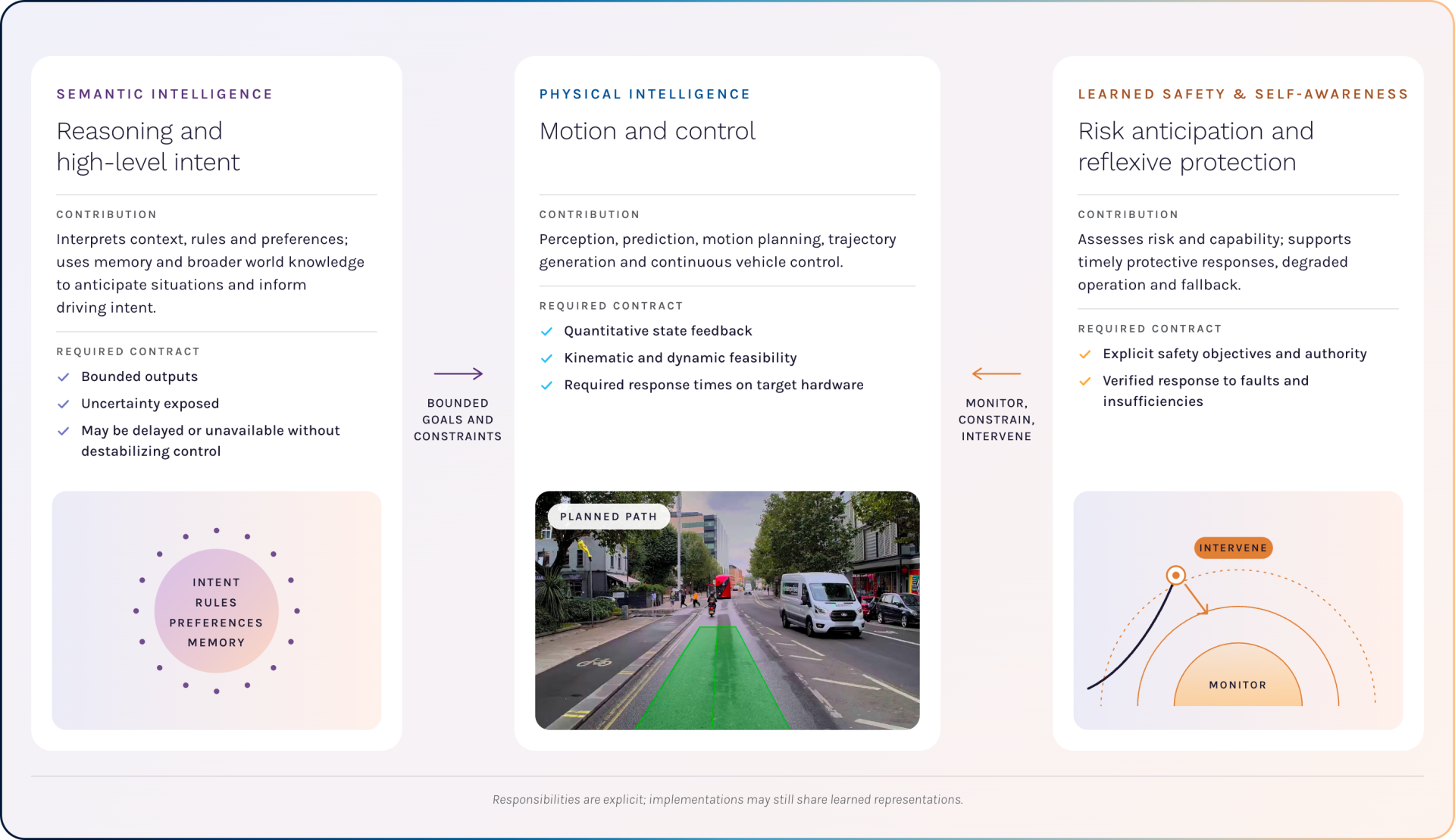
Figure 1 - Complementary responsibilities within an integrated learned system. Safety assurance covers the complete system and the interactions between these capabilities
The decisive property is graceful degradation. Physical control must remain stable when language-based reasoning is slow, uncertain, or contradictory. If that reasoning is needed to continue the intended journey, losing it must trigger the appropriate degraded behavior or fallback; stable control alone is not sufficient.
Learned safety remains essential as language and reasoning capabilities improve. Verification and validation must assess the complete driving system, including how these capabilities interact and how the system responds when reasoning is delayed, mistaken or unavailable.
3. Use language where its value compounds
Language can deliver value throughout learning and around deployment, including the decisions the vehicle makes at runtime. Grounded reasoning can support earlier hazard anticipation, comparison of alternative plans, and interpretation of unfamiliar situations. Its development benefits also compound across the learning loop.
- Build the curriculum. Retrieve rare scenarios, describe interventions, cluster failure modes, balance datasets, and prioritize the next most valuable training examples.
- Strengthen representations. Align visual, spatial, temporal, and linguistic signals so that rules, interactions, and uncommon signs are easier to learn and query.
- Encode constrained intent. Translate route goals, user preferences, local rules, and operator input into typed, bounded objectives that a motion policy can accept, reject, or qualify.
- Expand the test space. Use text to specify scenario families and generate controlled variations. Let language ask the question; let simulation, track testing, and quantitative outcomes answer it.
- Accelerate debugging. Use commentary, retrieval, and counterfactual queries to help engineers find mismatches between what a model appears to attend to and what actually drives its behavior.
- Improve human interaction. Communicate intent, follow goals and preferences, ask clarifying questions, expose uncertainty, and support remote assistance without confusing communication with the safety mechanism itself.
This is a richer role than narration. Language becomes an instrument for supervision, decision-making, search, specification, testing, and interaction—while learned safety capabilities and whole-system verification and validation remain essential.
4. Safety needs anticipation as well as a fast response
Anticipating risk early and responding promptly are complementary safety requirements. Time-critical actions must meet the available response budget and remain physically feasible.
Consider a vehicle approaching a station where construction has closed the usual drop-off. A sign redirects passengers to the east entrance. Grounded language and reasoning can connect that instruction to the destination and revise the high level plan. As workers move through the access lane, the driving model adjusts its speed and path. Better understanding informs these decisions, while learned safety remains essential for anticipating risk and supporting timely, physically feasible responses.
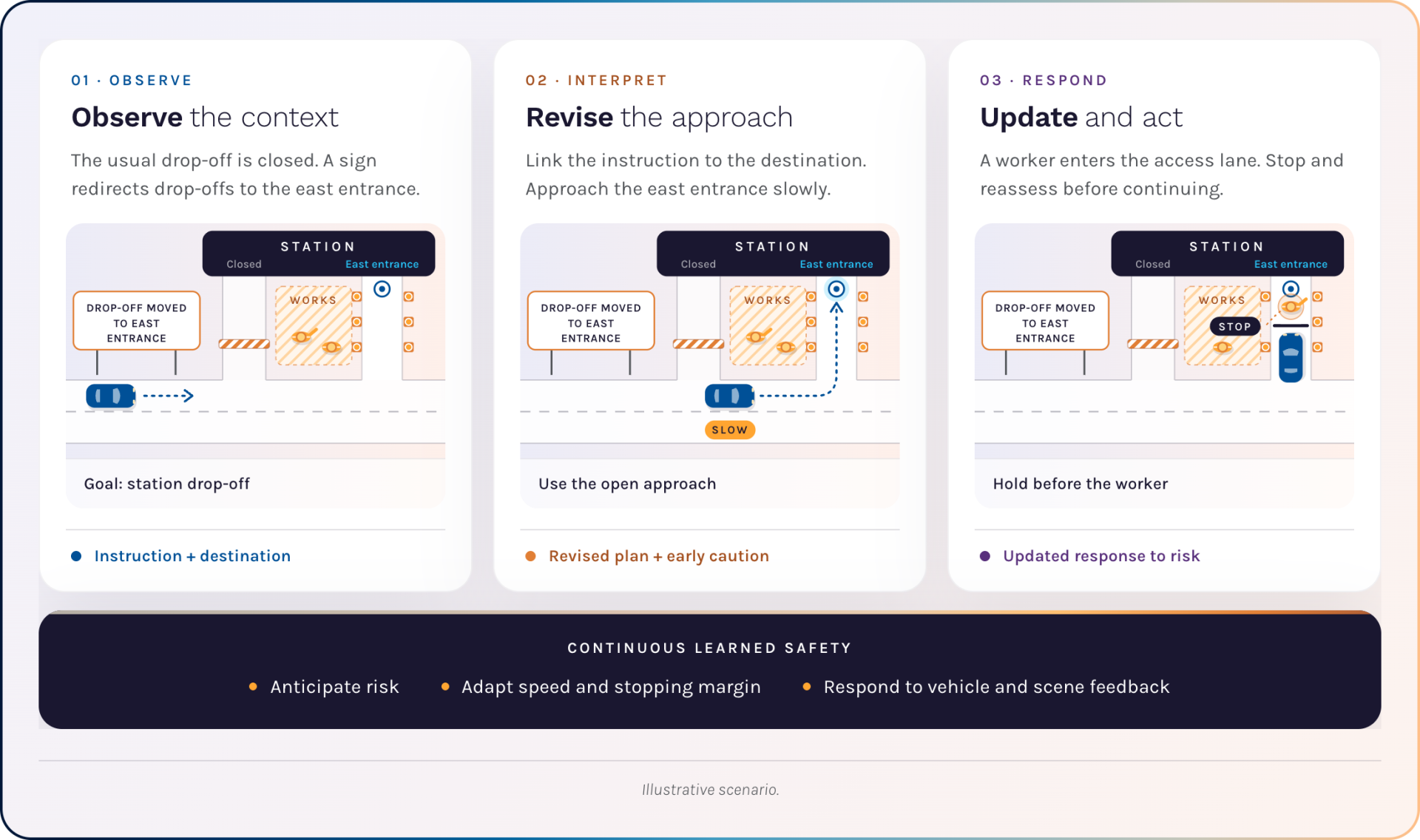
Figure 2 - Language and reasoning help interpret the situation and inform driving intent. Physical intelligence plans and executes feasible motion, while learned safety anticipates risk and supports timely intervention. Illustrative scenario
That understanding can inform earlier caution; it does not replace continuous risk assessment or the physical intelligence needed to execute responses within the vehicle’s kinematic and dynamic constraints.
Resolving the situation requires a continuously updated response: adapt speed to visibility, manage jerk, preserve stopping margin, retain feasible options, and adapt as the line-of-sight changes. The complete driving system must act within a verified latency budget using quantitative state feedback. It must not miss a required control deadline while waiting for open-ended language generation.
As “How Wayve Builds a Safe AI Driver,” describes, risk anticipation itself is learned end-to-end. It is a safety capability with its own objectives and evaluation, not an optional explanation or a hand-written checker made obsolete by stronger general reasoning.
What defines it is the operating contract: a high update rate, physically feasible outputs, bounded execution time, feedback from the vehicle and environment, and safe behavior when deliberative services are unavailable.
Deeper understanding can reduce the chance that a situation reaches the edge of the safety envelope. It can support earlier anticipation, high-level decision-making, or interpretation of unusual rules when time permits. The architectural requirement is that acute stabilization and collision avoidance must respect the vehicle’s kinematic and dynamic constraints, meet the required response times, and do not depend on an unbounded reasoning process.
5. Measure the vehicle, not the narrative
Every claim that language improves embodied AI driving should pass a production accountability framework. As “Validating the AI Driver” showed, the relevant unit of evidence is the complete system operating in closed loop, not the eloquence of a reasoning trace or a curated benchmark example.
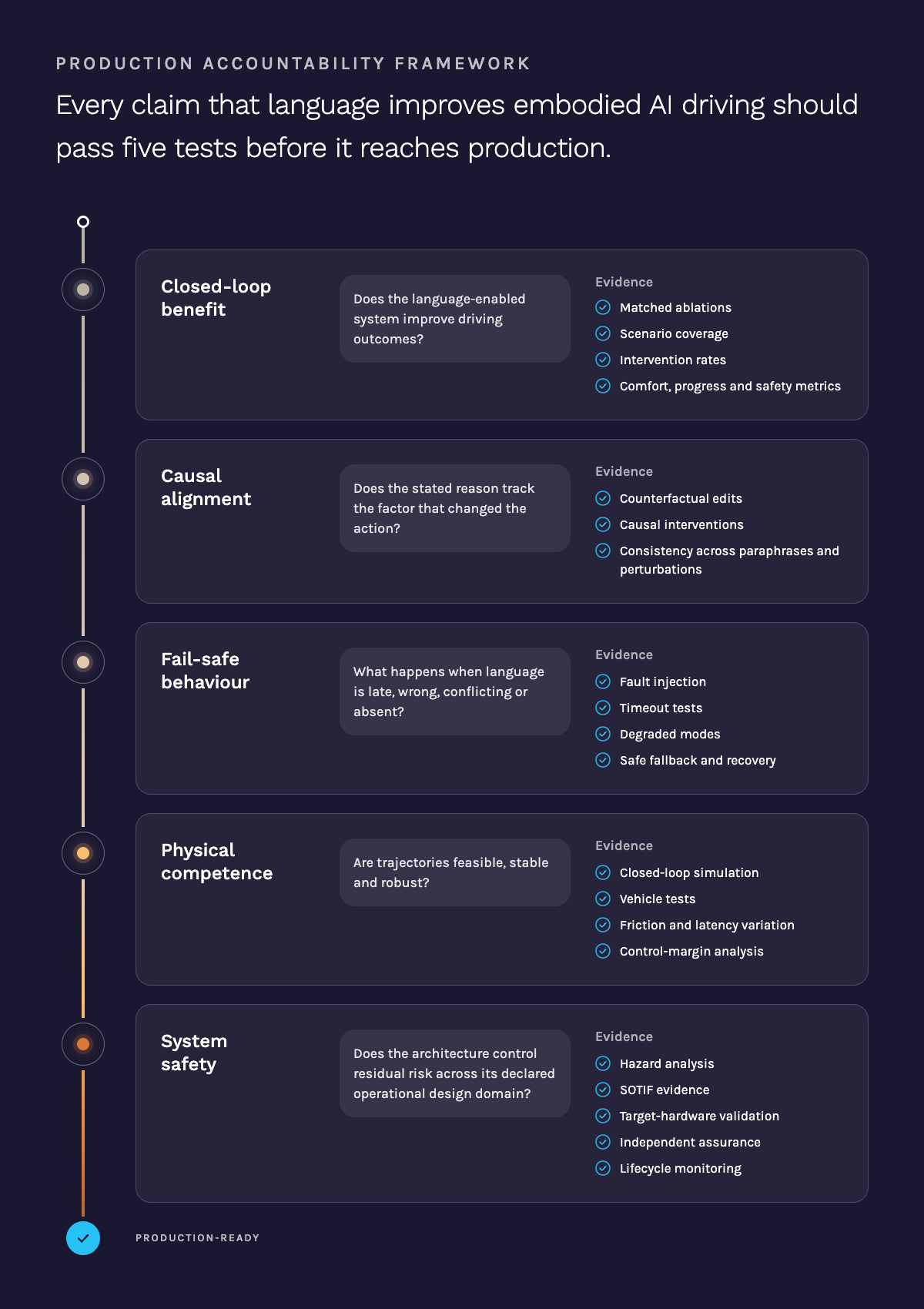
These tests should run on the intended compute platform and across the declared operational design domain. Model scale, open-loop benchmarks, and convincing commentary can be useful development signals. None substitutes for a system-level safety argument that covers functional faults, performance insufficiencies, foreseeable misuse, and change over the product lifecycle.
Production accountability begins where the demonstration ends: representative data, intervention learning, physical modeling, closed-loop simulation, vehicle integration, fault injection, verification and validation, and independent assurance.
6. A better definition of embodied intelligence
The destination is not a machine that talks, thinks, and controls without clear safety and timing requirements. Nor is it a return to brittle, hand-built stacks. It is an integrated learning system that is fluent in semantics and physics, with responsibilities defined clearly enough to test, constrain, and trust.
Language can teach rules, expose intent, enrich data, organize experience, and support long-horizon strategy. These benefits can be learned into the policy that drives. But when milliseconds separate recognition from collision, safety cannot depend on verbal fluency. The vehicle must already know how to act.
Language should ride shotgun: helping the AI Driver interpret situations, anticipate events and influence the intent. Physical intelligence provides kinematically grounded action, while learned safety supports risk anticipation and protection, and rigorous validation establishes whether the complete system is ready for the road.
4 November 2026 | Engineering
Validating the AI Driver
In Part 2 of our series exploring our approach to learned safety, we explore how Validation 2.0 fundamentally reshapes how enterprises develop and deliver AV products beyond mere efficient scaling.
Read more
4 November 2026 | Engineering
Building a Safe AI Driver
In Part 1 of our series exploring our approach to learned safety, we explore how safety assessment is part of how the AI Driver makes decisions using the Wayve Learned Safety Envelope (LSE).
Read more
3 August 2026 | Research
GAIA-4: Multimodal World Models Powering Closed-Loop Simulation for Safe and Scalable Autonomy
The latest evolution of GAIA, GAIA-4, puts the Wayve AI Driver in the loop, transforming world modeling from scene generation into a way to measure end-to-end safety at scale.
Read more